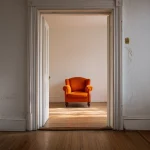


There was a room in my apartment that I kept not finishing.
I want to be clear about what I mean by that, because “unfinished” is one of those words that sounds like a practical problem. A budget problem. A time problem. What I mean is something more specific: I had the vision. I had most of the pieces. I knew what the room needed to become. And I kept finding reasons not to let it.
The room was an office. A place for reading and thinking and doing the kind of quiet work that doesn’t fit anywhere else. I had the chair I wanted. I had the lamp. I had a stack of books that had been patiently waiting for shelves. What I didn’t have, for two years longer than I should have, was the wall color.
I knew the color. That’s the part I’ve had to admit to myself. I wasn’t searching. I wasn’t still deciding. I had a specific shade of green in my head, the kind that sits somewhere between forest and shadow, a color that feels like the inside of a room that has always been a room. Not fresh green. Not hopeful green. Settled green. The green of a library nobody had to build because it had always existed.
I bought a sample. I painted a square on the wall. It looked exactly right.
And then I repainted that wall white and told myself I wasn’t sure.
I have a theory about unfinished rooms.
We talk about them the way we talk about projects we haven’t started and calls we keep meaning to make, as though the obstacle is external. Time. Money. Bandwidth. These are real constraints, and I won’t dismiss them. But for a certain category of unfinished room, the constraint isn’t material. The room stays unfinished because finishing it requires you to commit to something.
A finished room is a statement. It says: this is who I am, and I live here, and I believe in this enough to make it real. An unfinished room holds that moment in suspension. It lets you stay in the comfortable fiction of intention without the exposure of execution.
The office was that kind of room.
Because finishing it meant the room would exist in the world. People would see it. They would draw conclusions. They would know something about me that I had, apparently, decided I wasn’t ready for them to know.
This is the thing about dark colors in a room. They don’t whisper. A deep green wall doesn’t say I am considering a point of view. It says I have one. It doesn’t perform neutrality or leave interpretive room for whoever walks in. It commits. And I was afraid of what that commitment would reveal, not about my taste, but about my interiority. About the kind of quiet and depth I actually wanted to live inside, as opposed to the kind of lightness and openness that feels safer to project.
I’ve thought about what it means that the room I was afraid to finish was a private one.
Not the living room, where guests arrive and first impressions form. Not the kitchen, that most social of spaces. The room that stopped me was the room nobody was required to see. Which says something I’m still working out. Either I was afraid of my own judgment, of sitting in that green room alone and having to reckon with what it meant to want that much stillness. Or I was afraid that someone would see it anyway, would find their way to the room I hadn’t decorated for them, and discover something true about me that I hadn’t offered.
Both of these possibilities embarrass me a little. Both feel right.
The color went up on a Saturday in March.
I didn’t make a project of it. I didn’t move everything out, didn’t tape the trim with the precision I usually bring to that particular ritual. I mixed the paint, and I did the thing, and when I was done, I sat in the chair in the middle of the room and looked at the walls.
The room looked like itself. That’s the only way I know how to describe it. Not finished in the sense of complete, because there is still a shelf I haven’t hung and a rug that might not be right. But finished in the sense that it had arrived at something true. The color was what I had known it would be two years earlier. Settled. Serious. Not decorative. The room felt like a decision rather than a default.
I sat there for a while, longer than I expected to.
What I felt was not pride exactly, and not satisfaction in the way that finishing a task produces satisfaction. It was closer to relief. The relief of no longer pretending the hesitation was about anything other than what it was.
I think we leave rooms unfinished for the same reasons we leave parts of ourselves unexpressed.
Because expression is exposure. Because committing to a vision, in color or in any other medium, means standing behind it. Means saying this is what I chose, and I chose it knowing what it would look like, and I chose it anyway. That is, it turns out, a harder sentence to mean than it appears.
The room I was afraid to finish was not really about the room. It was about whether I trusted my own gut enough to let it take up space. Whether I believed the things I wanted, the stillness and the depth and the particular quality of green that has no interest in being anyone’s idea of cheerful, were things worth making room for.
The answer was yes. It took me two years to say it out loud.
What is still true, and what I think is worth saying, is that the color didn’t change the room. The decision did. The paint was always going to look the way it looks. What changed was my willingness to let it.
There is a room in your house that you know the answer to.
Not a guess. Not a someday. The answer you already have but haven’t acted on, because acting on it means something. The color you keep coming back to and keep finding reasons to defer. The piece you haven’t hung. The corner that’s been holding its breath.
The room is waiting for you to finish what you started when you first knew what it was supposed to be.
The only question is what you’re waiting for it to be safe from.
If this piece made you slow down and think, the newsletter was made for you. Weekly, free, and written for the reader who reads all the way to the end. One letter. One idea. The color of the week, the room worth studying, the question worth sitting with.
Subscribe Free