

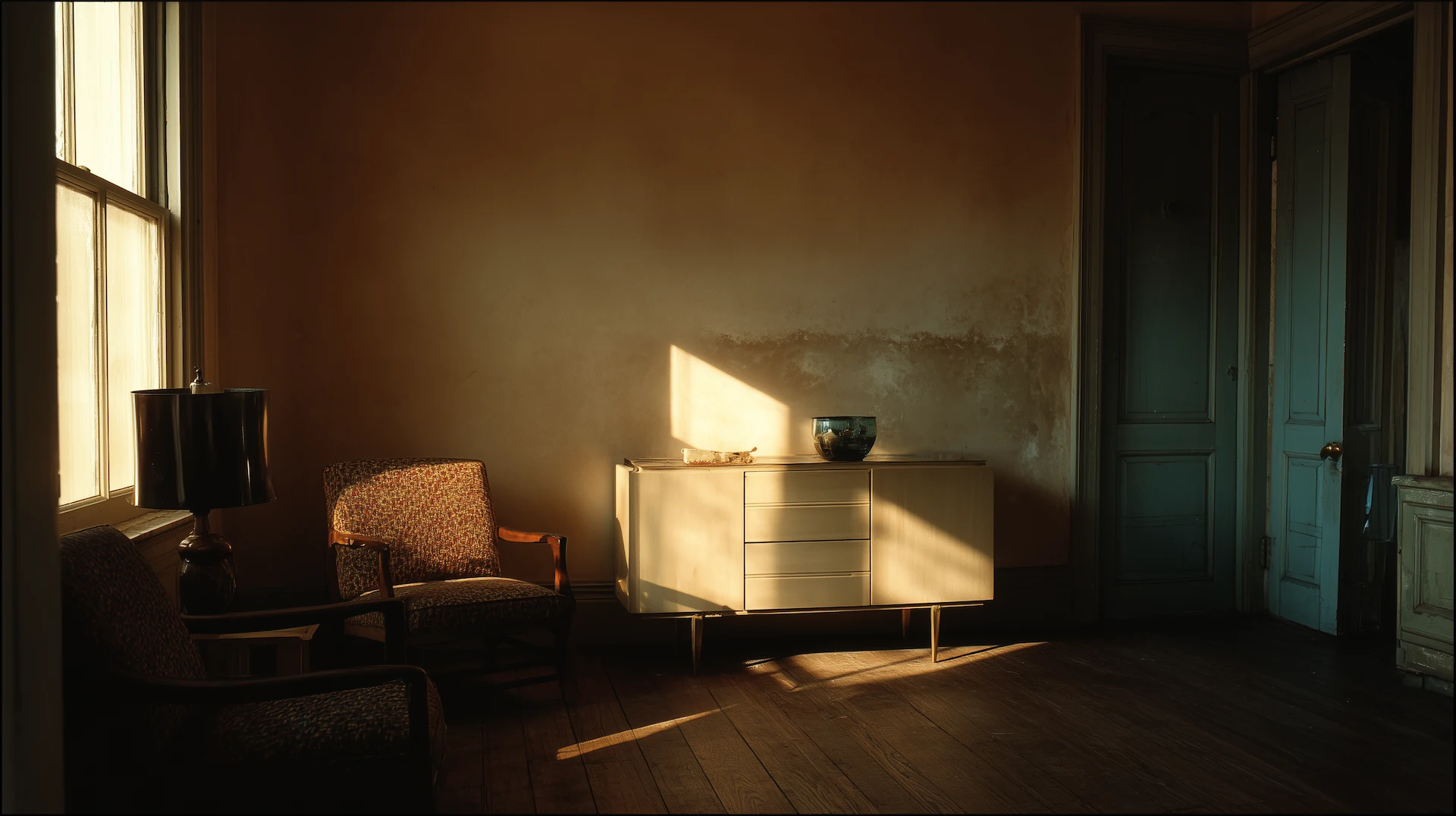
There is a sofa in your living room that you did not choose.
Maybe it came from a grandmother who was downsizing. Maybe it arrived with a first apartment, free from a neighbor who was leaving, and you took it because free furniture is its own kind of logic. Maybe you bought it in a hurry, years ago, from a store you’d never shop at today, and now it sits there as evidence of who you used to be.
Whatever its origin, the sofa is large. It is expensive to remove. And because those two facts are true, the sofa has become the room’s first principle. Everything else has been arranged around it, in deference to it, in conversation with a color and scale and style you did not select. The rug went under it. The coffee table was chosen to complement it. The paint color went on the walls in a shade the sofa could tolerate.
You have been decorating for the furniture. Not for yourself.
Most people, if pressed, can identify the piece. The one that set the terms for everything else. And most people, if pressed further, will say some version of the same thing: I know it doesn’t really work, but I can’t get rid of it. Sometimes the reason is financial. Sometimes it’s sentimental. Sometimes the piece belongs to someone who is still alive and whose feelings are part of the calculation. And sometimes the real reason is harder to name: a quiet belief that replacing it would be wasteful, or vain, or an admission that you care about this more than a reasonable person probably should.
So the piece stays. And the room bends.
What happens when a room bends to a piece it can’t quite hold? It becomes an almost right room. The colors are nearly cohesive. The scale is mostly functional. The space feels like something you’re working around rather than something you’re living inside. People visit and say your home is nice. You say thank you. Neither of you is lying, but neither of you is saying the full truth either.
Here is the thing worth naming directly: inherited furniture is not just an aesthetic problem. It is an authority problem.
When a piece comes from someone else, especially someone you loved, or someone you once were, it arrives with a kind of gravitational pull that has nothing to do with whether you like it. The sofa is not just a sofa. It is your grandmother’s taste, still present in your living room, making decisions. The dining table from the first apartment is the version of you that didn’t know any better, casting a vote on every room you’ve had since. The free chair carries the logic of scarcity, the idea that what is available is what you deserve, that the room should be grateful for what it has.
These are not small forces. They shape spaces. And they are worth examining, not because inherited furniture is always wrong for a room. Sometimes a piece from someone you loved belongs exactly where it is, and you know it the moment you see it there. But they are worth examining because most of us have never examined them. We accepted the furniture and built around it, and called it decorating.
What we built, in some cases, was a room that belongs to someone else.
There is a particular version of this problem that goes deeper than style. It involves the pieces that were given with love and now feel impossible to release because of what releasing them might mean. The recliner a father sat in every evening. The side table from a marriage that ended. The cabinet a mother picked out and handed down as a form of care.
These pieces are not just furniture. They are proxies. And trying to decide what to do with them is rarely, at its core, a design question.
But the design question is still real. And it is worth separating. Because a room can hold memory without being governed by it. The recliner doesn’t have to be in the living room to honor the person who sat in it. The cabinet your mother chose doesn’t have to anchor your color palette to hers for her love to remain present in your life. Memory is more portable than furniture. It lives in you, not in the object.
This is worth saying because the alternative is a room that is a memorial rather than a home. And most of the people who are living in rooms like that are not doing it intentionally. They arrived there one accommodation at a time.
Some conversations belong in a letter.
Hue & Human — weekly, free, written for the reader who goes further.
Deciding the room should be yours is not an event. It is a series of smaller decisions, made when you are ready to make them.
Sometimes it starts with paint. Not reupholstering the sofa, not replacing the dining table, but putting a color on the walls that you actually want to live with and watching what the room says back. Sometimes it starts with one new piece that you chose entirely for yourself, that doesn’t negotiate with what was already there, that simply asserts: I live here. And sometimes, eventually, it starts with a conversation you have to have with yourself about what you’re preserving and why, and whether the room you’re living in is the room you would build if you were starting from now.
That last conversation is the hardest one. It is also the most useful.
Your space should tell the truth about who you are. Not who you used to be, not who someone you loved was, not who you were when you took the free sofa because free was what made sense that year. The room is not a museum. It is not a tribute. It is the place where your life is happening right now, and it is allowed to reflect that.
The furniture that was given to you served someone. Maybe it still serves you. But if you have been arranging everything else around a piece you didn’t choose, in a color you didn’t want, in a scale that crowds the room, it is worth asking the question clearly:
Who is this room for?
What color have you been putting off?
A note before you go: This is the kind of question that sounds simple and isn’t. If you’re sitting with it, the newsletter goes a little deeper. Hue & Human is where the thinking continues.
If this piece made you slow down and think, the newsletter was made for you. Weekly, free, and written for the reader who reads all the way to the end. One letter. One idea. The color of the week, the room worth studying, the question worth sitting with.
Subscribe Free