

The lease does not say you have to live like a placeholder.
Read it again if you need to. It says you can’t remove the built-ins, can’t install permanent fixtures, and must return the walls to their original condition when you leave. It does not say you have to spend the years in between pretending you don’t live there.
Somewhere, a generation of renters absorbed a different message. The message was: temporary means neutral. Impermanent means invisible. You don’t own it, so don’t touch it, don’t commit, don’t let it look like you. Hang your art with Command Strips and leave the rest alone. The beige is the landlord’s choice, and the landlord’s choice is the only choice available to you.
That is not a lease term. That is a philosophy. And it is one worth dismantling carefully, because the people living under it are paying for the privilege of living in a space that doesn’t know they exist.
Here is what the rental industrial complex actually sold: the idea that your relationship to a space is determined by your legal relationship to it. That ownership is the prerequisite for expression. That you cannot make a space yours unless the deed says so.
This is false. It has always been false. People have been making rented, borrowed, and temporary spaces deeply, specifically, unmistakably their own for as long as people have lived in spaces they didn’t build. The student who transforms a dorm room in a weekend. The immigrant family that turns a modest apartment into a home so full of color and texture and smell that walking into it feels like crossing into another country. The young professional who hangs her grandmother’s quilt on the wall of a downtown studio, and suddenly the room has a history it didn’t have that morning.
None of them owned the space. All of them lived in it.
What the beige mythology gets exactly backwards is the relationship between permanence and meaning. It assumes that real commitment requires lasting physical change. But meaning is not load-bearing. It does not require nails in studs. It requires presence. Intention. The decision to be fully in a space rather than passing through it.
There are real constraints in a rental. This piece is not going to pretend otherwise.
You probably can’t paint. Many landlords prohibit it, and even when the lease is silent, the cost of repainting on the way out can swallow a deposit. Structural changes are off the table. Installing the lighting you actually want is rarely worth the restoration math. These are genuine limitations, and a philosophy that ignores them is not a philosophy. It’s a mood board.
But the constraints are narrower than renters believe. What most leases prohibit is permanent alteration to the physical structure. They say very little about what fills the space. About what hangs from the walls by a hook rated for forty pounds. About what lives on the floors, the shelves, the windowsills. About what color the curtains are, how far they fall, and how much of the wall they cover when they’re open. About whether the furniture arrangement makes the room feel like a waiting area or like the living room of a person with opinions about how they want to move through the world.
The window of possibility inside a rental is wider than the mythology allows. What closes it is not the lease. What closes it is the belief that because some things can’t change, nothing should.
There is a specific kind of resignation I want to name here.
It’s the renter who says, “I’ll deal with it when I own a place.” It sounds practical. It is actually a form of deferral that compounds silently. Because the logic extends: I’ll care about how I eat when I’m less busy. I’ll deal with how I dress when I lose the weight. I’ll build the life I actually want when the conditions are finally right. The conditions are never finally right. And the years spent waiting for them are years spent in someone else’s idea of a room.
The life you are living right now deserves to look like you. Not the future you. The you who came home tonight, turned the key, and walked into that space. That person deserves color. Warmth. Something that signals, visibly and without apology, that someone with specific tastes and particular memories and a developing sense of what beauty means to them lives here.
A landlord does not get to determine whether you deserve that. A lease term does not get to determine whether you deserve that. A security deposit is not a toll for the right to be present in your own life.
What living in color in a rented space actually requires is not a different apartment. It is a different framework.
Some conversations belong in a letter.
Hue & Human — weekly, free, written for the reader who goes further.
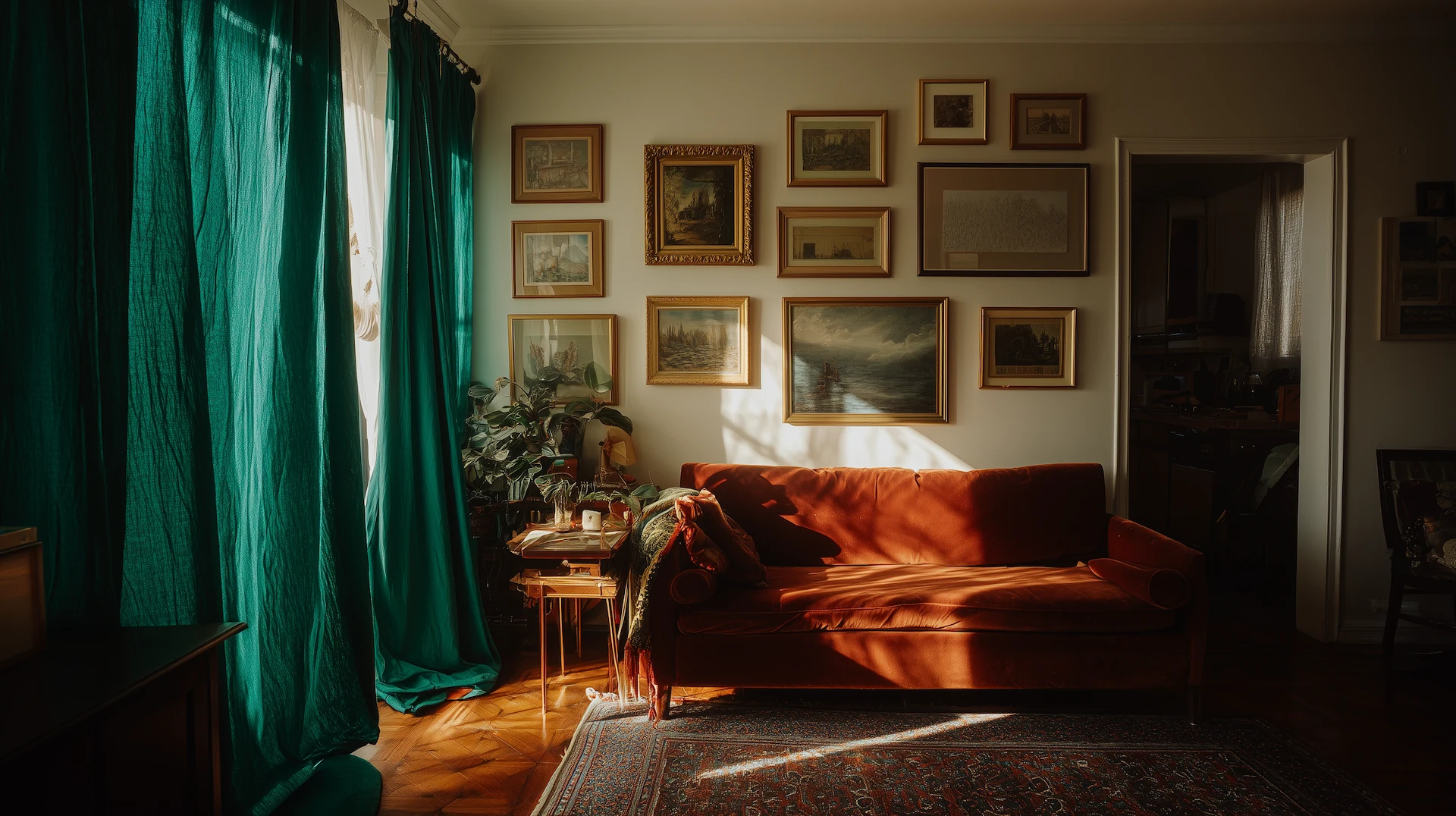
The framework starts with surfaces you control completely. Textiles are the most underused tool in the renter’s vocabulary. A rug in a deep, saturated color can override the emotional register of an entire room. Curtains that fall from ceiling to floor in the right shade make a white wall recede, and the room expand. A throw across a neutral sofa is not a substitute for a bold sofa. It is a decision in the same direction, made within the terms of the situation.
Then there is what you bring into the room. Not what you attach to it. A sideboard in a forest green, a bookshelf stacked with objects that have color and texture and meaning, a lamp with a terracotta shade casting warm light across a wall that is still technically beige. The wall doesn’t change. The room does. The room changes because you introduced objects with conviction, arranged them with care, and made a series of choices that add up to something that could only be yours.
And then there is light. Renters almost never think about light as a design tool, which is a loss. The light in a room is as negotiable as anything else. A bulb with a lower kelvin temperature turns an overhead fixture from interrogation room to evening warmth. A lamp placed in a corner instead of the center redistributes shadow in ways that reshape how a room feels at nine o’clock on a Tuesday night. None of this requires a landlord’s permission. All of it is design.
The framework is not a workaround. It is an argument. The argument is: expression does not require permanence. Color does not require ownership. A life lived fully in your space is not contingent on whether your name is on the deed.
The renters who have always known this are not the ones with the most money or the most square footage. They are the ones who decided, at some point, that the terms of their lease did not also determine the terms of their life.
Their apartments are saturated and specific. Filled with objects that mean something. Arranged with a care that a visitor would notice in under thirty seconds. They have made temporary spaces so thoroughly their own that leaving them at the end of a lease feels like grief.
That is not a design tip. That is a philosophy applied.
The question is not what your landlord will allow. The question is what you have been waiting for permission to be.
What color have you been putting off because the space isn’t yours yet?
If this piece made you slow down and think, the newsletter was made for you. Weekly, free, and written for the reader who reads all the way to the end. One letter. One idea. The color of the week, the room worth studying, the question worth sitting with.
Subscribe Free