
The front door is the only color decision most people make in full public view, and most of them make it by accident.
They choose what was already there. They choose what the house two doors down chose. They choose the safest thing the paint associate pointed to, the one described as “a classic,” which is a word that has been doing a lot of quiet work on behalf of fear for a very long time. They choose not to choose, which is, of course, also a choice.
The result is a neighborhood full of doors that say nothing. Or worse: doors that say please don’t look at me.
This is worth examining. Because the front door is not just a door. It is the most public color statement a home makes: the one visible from the street, the one a stranger reads before they know anything else about you, the one your guests see in the seconds before you open it. Everything the home wants to say about itself begins there. And most people hand that sentence over to inertia.
What the door is actually doing
When you walk up to a house and the front door is a particular color, something happens before you ring the bell. You form an impression. Not a judgment. An impression. The brain reads color faster than it reads language, faster than it registers the wreath or the welcome mat or the knocker shape. The color lands first.
A slate blue door says: composed. Maybe a little private. Somebody here cares about atmosphere. A glossy black door says: we take ourselves seriously, and we don’t apologize for it. A deep forest green says: rooted. The people inside probably own too many books and know exactly which direction the house faces at every hour of the day. A red door says something that has been said many times before. It is the door color with the most mythology and the most dilution, brave in theory, occasionally brave in practice.
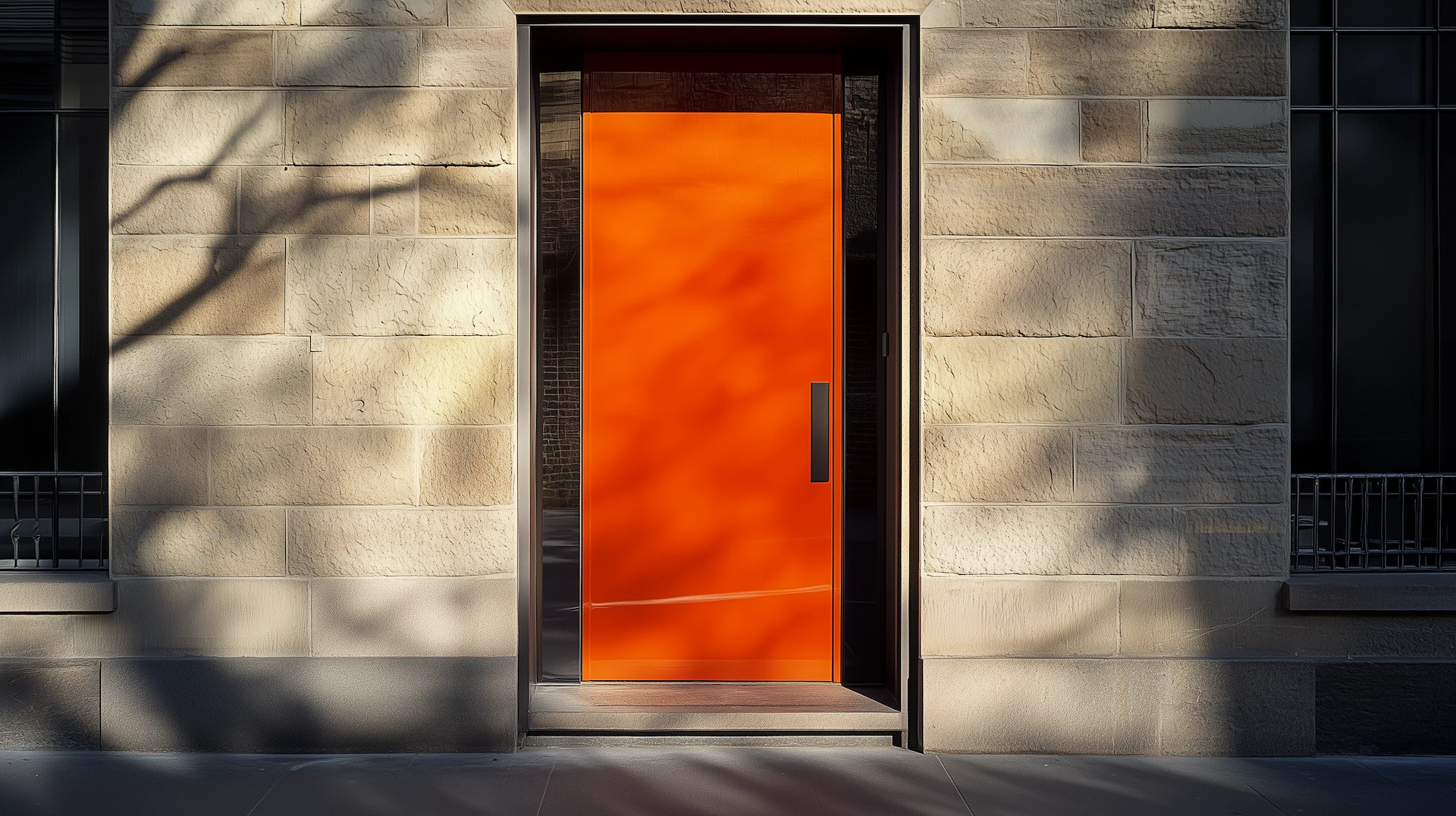
And a door painted with conviction, a high-gloss lacquer, an unexpected saturated hue, the kind of color that makes you slow down when you’re driving past, that door says something the house next door almost never says: someone lives here. Someone specific. Someone who decided.
The psychology of the threshold
There is something particular about the threshold as a psychological space. Every culture has understood this. The door is the boundary between inside and outside, between public and private, between who you are in the world and who you are at home. It is the last thing you see when you leave and the first thing you see when you return.
Painting that threshold a color you love, a color that feels true, is an act of orientation. It tells you something about yourself every time you come home. It says: yes. This is where I live. This is who I am here.
This is not small. The repetition of small truths is how identity solidifies.
Why most people don’t do it
The answer is almost never taste. People who say they are afraid to paint their front door a bold color are rarely lacking an opinion about what the color should be. They know. They have a favorite. They have saved the image somewhere, maybe more than once.
What they are afraid of is being seen.
A neutral door is plausibly deniable. It could belong to anyone. A saffron door, a cobalt door, a door the precise color of a ripe fig: that door belongs to a specific person who made a specific decision. It is attributable. It cannot hide behind “classic” or “timeless” or “it came that way.”
And something in us, shaped by a hundred small corrections toward conformity, hesitates at the moment of attribution. What will people think? Is it too much? Does it look like I’m trying?
The answer to that last question is yes. You are trying. That is the point. Trying is not a flaw in the execution. It is the whole argument.
Some conversations belong in a letter.
Hue & Human — weekly, free, written for the reader who goes further.
The neighbor problem
There is a particular paralysis that sets in when someone looks at their street and realizes that every door is a variation of the same four non-colors. The temptation is to read this as evidence, as confirmation that the neighborhood has decided, collectively, that boldness is not available here.
It is not evidence. It is a gap.
Every bold door that exists exists because someone went first. Before it was a statement, it was a decision made by one person who did not wait for permission. The door that stops traffic in your neighborhood, the one that makes strangers say oh under their breath as they walk past: that door began as a homeowner standing in front of a paint display with something they wanted and a reason not to want it.
They wanted it anyway.
What you are actually afraid of
The fear beneath the fear is not the neighbors. It is the permanence of the declaration. A neutral door means the statement is deferred. A painted door means the statement has been made. And making a statement about who you are, clearly and visibly and in full color, carries a vulnerability that choosing beige simply does not.
This is true. I am not going to argue that it isn’t.
I will say this instead: the vulnerability is the point. A home that tells the truth about who lives inside it is a home that has been claimed. Not decorated. Claimed. There is a difference, and it is not a small one.
The claiming begins at the door.
One more thing
The next time you walk up to a house with a front door that stops you, notice what you feel. Not what you think about the color, not whether you would choose it. What you feel in the half-second before analysis kicks in.
It is something close to recognition. Someone made something true here. The house knows what it is.
That feeling is available to you. It begins with a color. It begins at the door.
If this piece made you slow down and think, the newsletter was made for you. Weekly, free, and written for the reader who reads all the way to the end. One letter. One idea. The color of the week, the room worth studying, the question worth sitting with.
Subscribe Free