

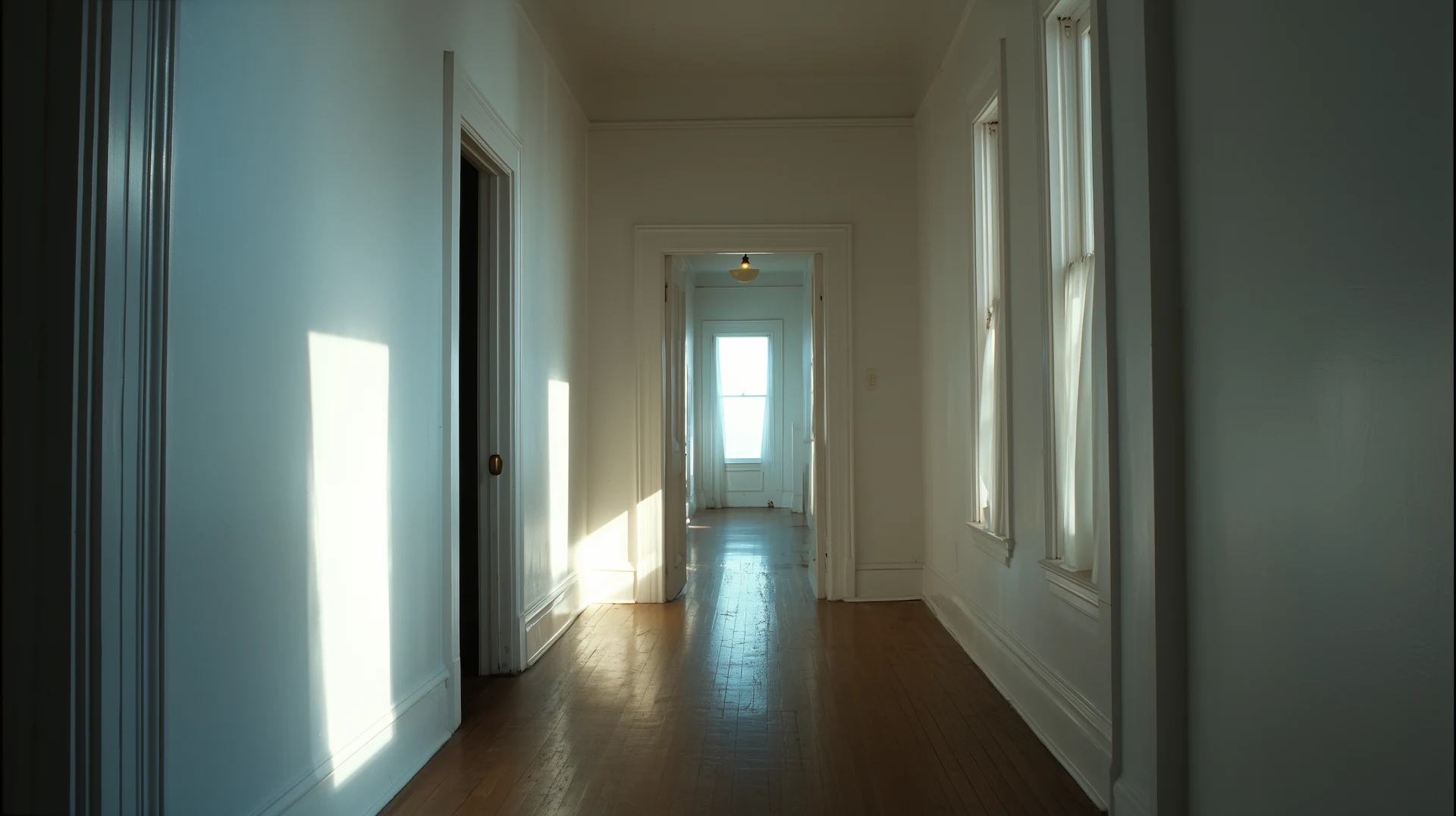
There is a room I keep returning to in my mind. Not because it is beautiful, though it is. Not because it is striking, though it stops you. I return to it because it unsettles something I thought I believed completely.
The room is white. Not off-white. Not warm linen, not aged cream. White. The walls are white. The sofa is white. The linen curtains, unlined, let the afternoon through without filtering it. There is a single low table in natural oak. A stack of books. One clay bowl, unglazed. Nothing else.
No color. And I cannot stop thinking about it.
This is supposed to be my problem. I have built an entire philosophy around the idea that color is not decoration — that it is expression, identity, memory, courage made visible. I have argued, in this space and in my own life, that the bold choice is the honest one. That the room that tells the truth about who you are is never the beige one.
So what do I do with this white room? What do I do with the fact that it is one of the most intentional spaces I have ever seen?
I sit with it. And I let it change my argument.
Here is what I have come to understand: the philosophy was never about color. It was always about intention. Color was the vehicle I chose because it is the most visible one. Because it is the place where people most consistently choose fear over honesty. Because a person who finally chooses the orange they have been putting off for three years is, in that choice, doing something real.
But intention does not require color to prove itself.
The white room is not a room without choices. It is a room where every choice has been made in the same direction toward stillness, toward form, toward the experience of being in a space without visual interruption. That requires courage, too. A different kind, but courage. Because in a culture that has decided maximalism is the current expression of personality, choosing restraint looks like cowardice to people who have not thought carefully about what restraint actually does.
It does nothing. It does something very specific. It removes the noise so the architecture can speak. It asks for the light to be enough. It trusts the object more than the palette. That is not decoration. That is a point of view.
I want to name what I am not saying. I am not saying that white rooms are brave and orange rooms are easy. I am not reversing the argument. Color is still the language I believe in. The person who has been living in beige out of habit, out of insecurity, out of a vague sense that bold choices are not for people like them, that person still needs to pick up the brush. That is still true.
What I am saying is that the honest version of the HoH philosophy has to hold space for the person who has thought carefully about color and chosen, deliberately and with full knowledge of what they are doing, not to use it.
That is a very different thing from the person who chose beige because they were afraid.
Intention is the distinction. It is the only distinction that matters.
I have a name for what I am describing. I call it the discipline of subtraction. It is not minimalism in the design-trend sense. I am not talking about a philosophy of owning fewer things, or the particular visual vocabulary that emerged from mid-century Scandinavian design and was then appropriated, flattened, and sold back to us as a personality. I am talking about something older and harder. The practice of removing everything from a space until only what is true remains.
In ceramics, there is a Japanese tradition of leaving a piece partially unfinished — not because the maker ran out of time or nerve, but because the incompletion is part of the meaning. The glaze stops here. The surface breaks here. The thing that could have been added was considered and set down.
That is what the white room was doing. Not refusing color. Setting it down.
The bravest color decision I know of is not always the most saturated one. Sometimes it is the one that says: I considered everything available to me, and I am asking you to experience what remains when I remove the obvious.
That takes a particular kind of confidence. Because the person who walks into a white room that has not been made with that intention, the white room because someone was afraid of being wrong, that room reads immediately as absence. As giving up. The eye knows the difference between a space that is empty and a space that is quiet. The difference is the same as the difference between silence and saying nothing.
Some conversations belong in a letter.
Hue & Human — weekly, free, written for the reader who goes further.
Color, at its best, is not what fills a room. It is what a room decides to say. And sometimes what a room decides to say is: I will let you bring the color. I will let your red coat against the sofa be the only saturated thing in here, and it will be enough, and it will be yours.
That is hospitality as design philosophy. That is generosity as restraint.
The A Different Hue series exists because I believe a brand that can argue both sides of its own thesis, without losing its conviction in either direction, is a brand worth trusting. This is the first installment. It will not be the last.
What I am committed to, in this space and everyone that follows, is intention. Not a palette. Not a principle about whether bold is better or quiet is wiser. Intention. The question is never what color did you choose. The question is always: Did you choose it?
There is a room that is white because someone was afraid. And there is a room that is white because someone thought carefully about every color available to them and decided that light was enough.
One of them has something to say. One of them is still waiting for permission.
I think you know which is which.
What color have you been putting off? And is it possible that the most honest version of that question has nothing to do with adding something?
If this piece made you slow down and think, the newsletter was made for you. Weekly, free, and written for the reader who reads all the way to the end. One letter. One idea. The color of the week, the room worth studying, the question worth sitting with.
Subscribe Free